One Step Nucleic Acid Amplification (OSNA) Lysate Samples Are Suitable to Establish a Transcriptional Metastatic Signature in Patients with Early Stage Hormone Receptors-Positive Breast Cancer
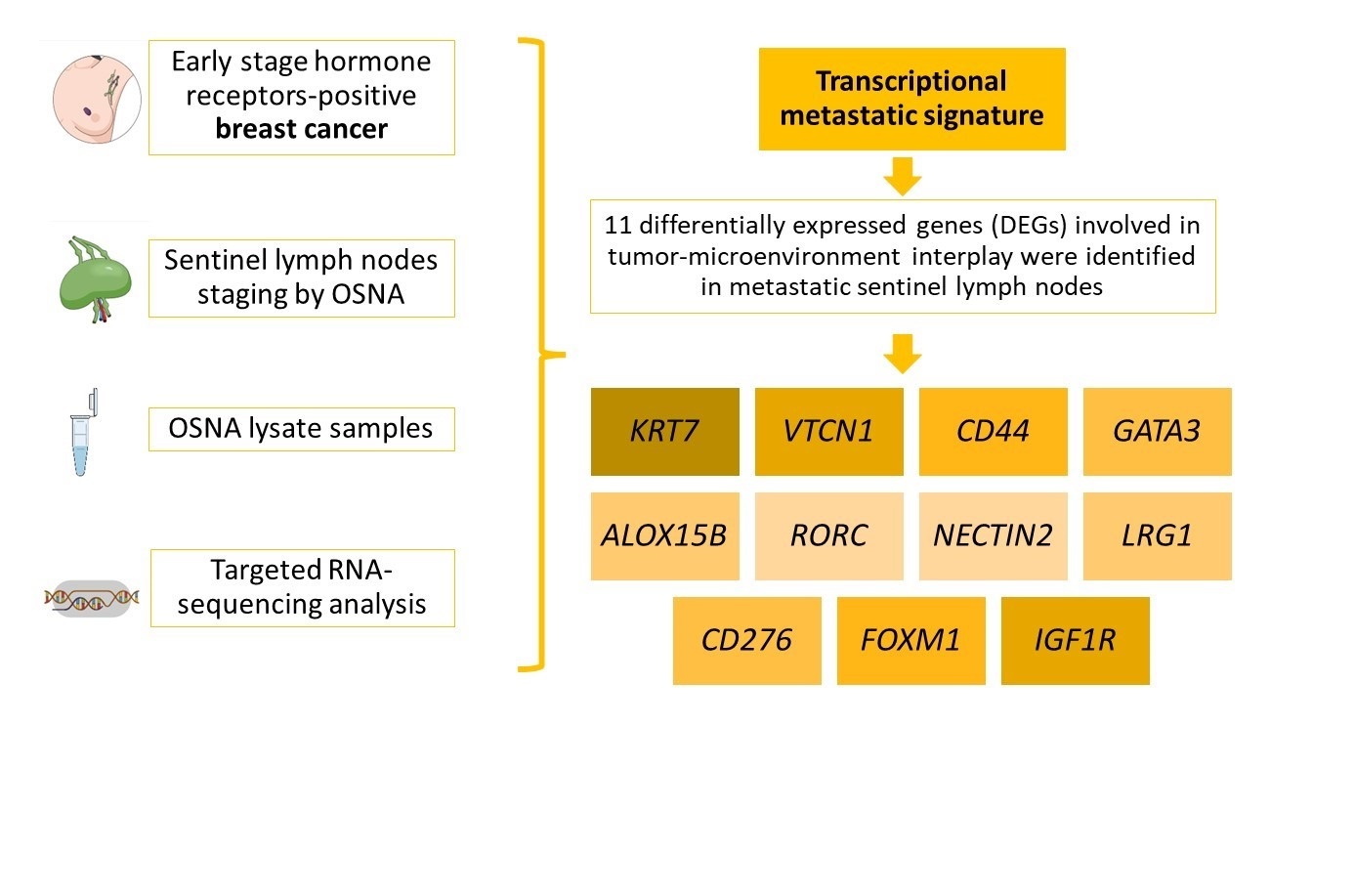
The One Step Nucleic Acid Amplification (OSNA) is a recent technique for sentinel lymph nodes staging in breast cancer (BC). After OSNA assay, instead of being discarded, the residual OSNA lysate can also be used for gene expression studies, being the potentially ideal sample to search for new biomarkers. The aim of our study was to identify biomarkers related to tumor-microenvironment interplay in OSNA lysate of sentinel lymph nodes in women with early stage hormone receptors-positive BC. We identified 11 upregulated genes in metastatic lymph nodes. These genes codify proteins mainly involved in cancer aggressiveness and with impact in immune response. Thus, these findings support that OSNA lysate transcriptomic analysis may identify biomarkers potentially useful in the future for prognosis stratification and therapy selection. As OSNA assay is being implemented for sentinel lymph nodes staging in other cancers, this approach could also have a wider utility.
Authors and Affiliations:
Inês Gante 1,2,3,Joana Martins Ribeiro 4, João Mendes 3,4, Ana Gomes 5, Vânia Almeida 5,6, Frederico Soares Regateiro 3,7,8, Francisco Caramelo 3,9,10, Henriqueta Coimbra Silva 3,4,10 and Margarida Figueiredo-Dias 1,2,3
Related news
Genetic Variants in Amino Acid Transporters Associated with Prognosis in Colorectal Cancer
A study published in Anticancer Research identified genetic variants in SLC1A5, SLC7A5, and SLC3A2 associated with survival in colorectal cancer patients. These findings highlight the role of tumor genetics in prognostic stratification and personalized treatment approaches. Authors and Affiliations: Catarina Lopes (1,2,3), Catarina Macedo-Silva (4), Mónica Farinha (5), João Costa (5), Sofia Pinelas (6), Isabel…
Researchers discover that Metformin reduces the anti-tumour effect of Linsitinib in the treatment of ovarian cancer
Authors and Affiliations: Diana Luísa Almeida-Nunes 1,2,3, João P. N. Silva 4, Mariana Nunes 3,5, Patrícia M. A. Silva 1,4,6, Ricardo Silvestre 7,8, Ricardo Jorge Dinis-Oliveira 1,6,9,10, Hassan Bousbaa 4 and Sara Ricardo 1,2,3,4, 1 Associate Laboratory i4HB—Institute for Health and Bioeconomy, University Institute of Health Sciences—CESPU, 4585-116 Gandra, Portugal. 2 UCIBIO—Applied Molecular Biosciences Unit,…
Breast cancer screening: X-ray dosimetry in of 2D and 3D mammography exams
Mammography screening using X-rays for early breast cancer detection, allows saving millions of lives, has been proven in several surveys and studies over the last three decades. The estimation of the radiation dose received by the breast, a radiation-sensitive organ, is quantified using the Mean Glandular Dose (MGD). It is important to understand that the…
i3S researchers develop a new strategy to create super CAR-T cells against solid tumors
A team from the Institute for Research and Innovation in Health at the University of Porto (i3S), led by Salomé Pinho, has discovered a new strategy to make (CAR-)T cell therapies more effective against solid tumors. The findings were published in Cancer Immunology Research, a journal of the American Association for Cancer Research (AACR). The…
Therapeutic properties of Ridolfia segetum (L.) Moris essential oil against cancer cells
Plants have an important role in traditional medicine, once they present several therapeutic properties, including anti-inflammatory, antioxidant and antitumoral. An interesting fact show that, currently, more than 60% of the available drugs used in the clinic to treat cancer derive from natural products or are inspired in their chemical structure. Therefore, plants play a key…
The communication network of pancreatic cancer
Recent advancements in mouse models for studying exosomes have provided new insights into their roles in various biological contexts. Exosomes are tiny particles that cells release to communicate with each other. Using a new genetic mouse model, we tracked exosomes from pancreas cells and studied their behavior during pancreatic ductal adenocarcinoma, a type of pancreatic…