3D nano fabrication for single molecule microscopy
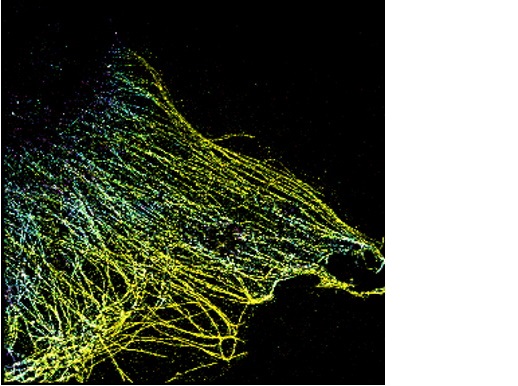
The new focus-locking technique involves growing cell on glass coverslips with specially 3D-printed nanometre particles called ‘fiducials’, which act as markers to stabilise or ‘lock’ the microscope as it is recorded. Being able to control the 3D-architecture and positioning of the guide markers at the nanoscale means that microscopists have greater control of the imaging.
Authors and Affiliations:
Related news
Graphene-based nanomaterials coated with Hyaluronic Acid for application in Chemo-Photothermal therapy of breast cancer cells
Authors and Affiliations: Rita Lima-Sousa a, Bruna L. Melo a, António G. Mendonça a,b, Ilídio J. Correia a,c, Duarte de Melo-Diogo a a CICS-UBI – Centro de Investigação em Ciências da Saúde, Universidade da Beira Interior, 6200-506 Covilhã, Portugal b Departamento de Química, Universidade da Beira Interior, 6201-001 Covilhã, Portugal c CIEPQPF – Departamento de…
Repurposing Positive Inotropic Agents as a Potential Strategy for Personalized Treatment of Bladder Cancer
Authors and Affiliations: Eduarda Ribeiro 1,2 and Nuno Vale 1,3,4,* 1 PerMed Research Group, RISE-Health, Faculty of Medicine, University of Porto, Alameda Professor Hernâni Monteiro, 4200-319 Porto, Portugal; [email protected] 2 School of Medicine and Biomedical Sciences (ICBAS), University of Porto, Rua de Jorge Viterbo Ferreira, 228, 4050-313 Porto, Portugal 3 RISE-Health, Department of Community Medicine,…
Factors and biomarkers explaining disparities in survival outcomes of early stage gastric cancer between western and eastern world regions
Authors and Affiliations: Carla Pereira1,2,3, Ji-Hyeon Park4, Sofia Campelos1,5, Irene Gullo1,6,7, Carolina Lemos1,8,9, Leslie Solorzano10, Diana Martins1,2,11, Gilza Gonçalves2, Dina Leitão6,7, Hyuk-Joon Lee4,12,13, Seong-Ho Kong4,13, Ana André1,2, Clara Borges14, Daniela Almeida14, Carolina Wälbhy10, Raquel Almeida1,2,7,15, Woo Ho Kim16, Fátima Carneiro1,2,6,7, Han-Kwang Yang4,12,13, Gabriela M. Almeida1,2,7, Carla Oliveira1,2,7 1 i3S—Instituto de Investigação e Inovação em Saúde,…
Diosgenin and G protein-coupled estrogen receptor as partners against prostate cancer
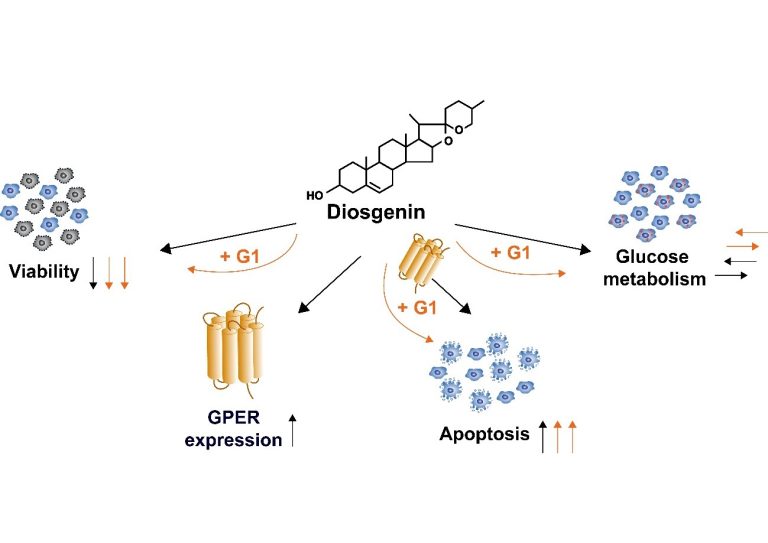
Study shows that diosgenin, a phytosteroid sapogenin, suppresses viability and promotes apoptosis of human prostate cancer cells with effects enhanced by the activation of the G protein-coupled estrogen receptor activation. Authors and Affiliations: Marília I. Figueira1, Ricardo Marques2, Henrique J. Cardoso1, Lara R. S. Fonseca1, Ana P. Duarte1, Samuel Silvestre1 and Sílvia Socorro1 1CICS-UBI—Health Sciences…
Pro-inflammatory IL-6 triggers overexpression of splice variant RAC1B
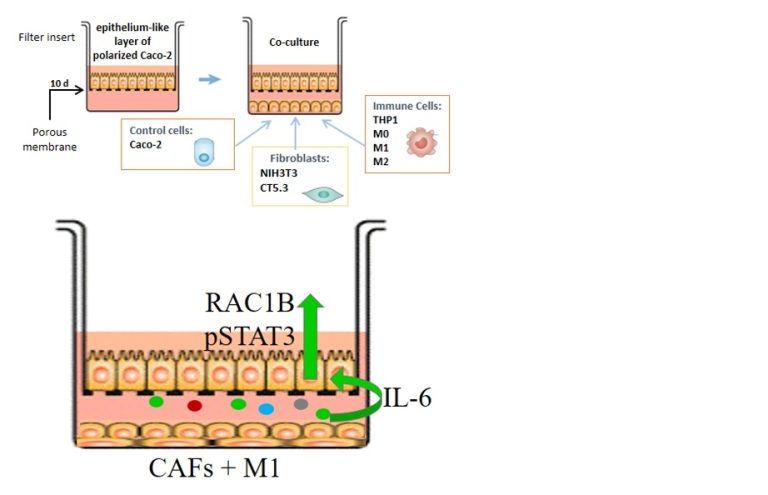
Authors and affiliations:Joana FS Pereira, Cláudia Bessa, Paulo Matos and Peter Jordan Instituto Nacional de Saúde Doutor Ricardo Jorge, BioISI- Biosystems & Integrative Sciences Institute, Faculdade de Ciências da Universidade de Lisboa Abstract:An inflammatory microenvironment is a tumour-promoting condition that provides survival signals to which cancer cells respond with gene expression changes. One example is…
The risk of colorectal cancer in patients with Inflammatory Bowel Disease
Patients with inflammatory bowel disease (IBD), which includes Crohn’s Disease and Ulcerative Colitis, are at increased risk of developing colorectal cancer (CRC) when compared to the general population. Colorectal cancer associated with long-lasting (more than 8-10 years of diagnosis) bowel inflammation (colitis) is one of the major complications of inflammatory bowel disease. The mechanisms underlying…