Preclinical validation of a new hybrid molecule loaded in liposomes for melanoma management
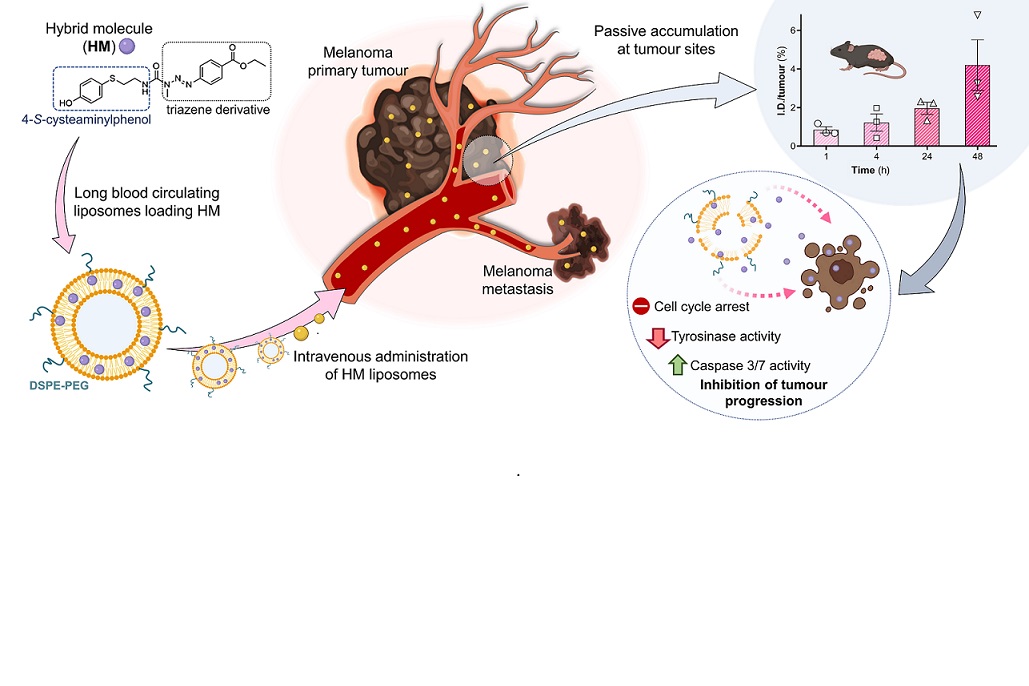
The aggressiveness of melanoma and lack of effective therapies incite the discovery of novel strategies. Recently, a new dual acting hybrid molecule (HM), combining a triazene and a ʟ-tyrosine analogue, was synthesized. HM was designed to specifically be activated by tyrosinase, the enzyme involved in melanin biosynthesis and overexpressed in melanoma.
HM displayed remarkable superior antiproliferative activity towards various cancer cell lines compared with temozolomide (TMZ), a triazene drug in clinical use, that acts through DNA alkylation. In B16-F10 cells, HM induced a cell cycle arrest at phase G0/G1 with a 2.8-fold decrease in cell proliferation index. Also, compared to control cells, HM led to a concentration-dependent reduction in tyrosinase activity and increase in caspase 3/7 activity.
To maximize the therapeutic performance of HM in vivo, its incorporation in long blood circulating liposomes, containing poly(ethylene glycol) (PEG) at their surface, was performed for passively targeting tumour sites. HM liposomes (LIP HM) exhibited high stability in biological fluids. Preclinical studies demonstrated its safety for systemic administration and in a subcutaneous murine melanoma model, significantly reduced tumour progression. In a metastatic murine melanoma model, a superior antitumour effect was also observed for mice receiving LIP HM, with markedly reduction of lung metastases compared to positive control group (TMZ).
Biodistribution studies using 111In-labelled LIP HM demonstrated its ability for passively targeting tumour sites, thus correlating with the high therapeutic effect observed in the two experimental murine melanoma models.
Overall, our proposed nanotherapeutic strategy was validated as an effective and safe alternative against melanoma.
Authors and Affiliations:
1Research Institute for Medicines, iMed.ULisboa, Faculty of Pharmacy, Universidade de Lisboa, Portugal.
Abstract:
Journal: Biomedicine & Pharmacotherapy
Link: https://www.sciencedirect.com/science/article/pii/S075333222201410X?via%3Dihub
Related news
Bringing vascularization into glioblastoma in vitro models
Authors and Affiliations: Catarina Pacheco1,2,3, Fátima Baltazar4,5, Bruno M. Costa4,5, Bruno Sarmento 1,2,3 1i3S – Instituto de Investigação e Inovação em Saúde, Universidade do Porto, Rua Alfredo Allen 208, 4200-393 Porto, Portugal 2INEB – Instituto Nacional de Engenharia Biomédica, Universidade do Porto, Rua Alfredo Allen 208, 4200-393 Porto, Portugal 3UNIPRO – Oral Pathology and Rehabilitation…
New Approach Combines EGFR and Cell Division Pathways to Boost Oral Cancer Treatment
Authors and Affiliations: Mafalda Calheiros-Lobo 1,†,João P. N. Silva 1,†,Leonor Delgado 1,2,Bárbara Pinto 1,3,Luís Monteiro1,4,Carlos Lopes 1, Patrícia M. A. Silva 1,5,6,* and Hassan Bousbaa 1,* 1UNIPRO—Oral Pathology and Rehabilitation Research Unit, University Institute of Health Sciences (IUCS), Cooperativa de Ensino Superior Politécnico e Universitário (CESPU), Rua Central de Gandra, 1317, 4585-116 Gandra, Portugal 2Pathology…
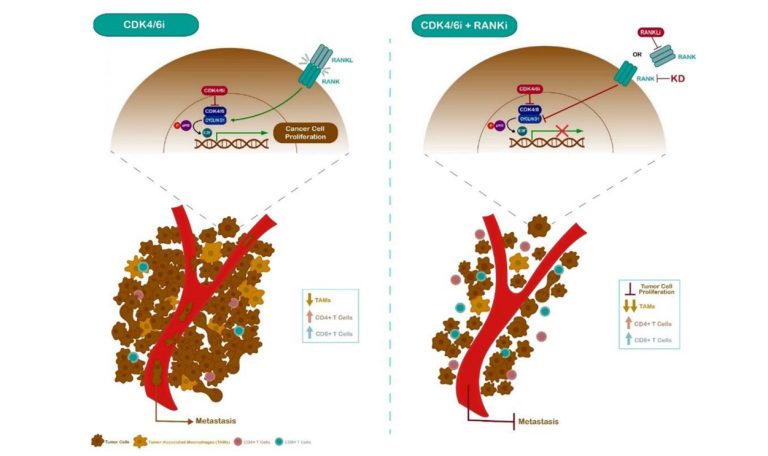
RANK pathway inhibition sensitizes triple-negative breast cancer to CDK4/6 inhibitors and enhances immune response
This study, led by Sandra Casimiro and Luis Costa from the Oncology Translational Lab at GIMM CARE, part of the GIMM Foundation – Gulbenkian Institute for Molecular Medicine, demonstrates the potential efficacy of a novel therapeutic strategy for triple-negative breast cancer (TNBC) — an aggressive form of breast cancer for which treatment options are largely…
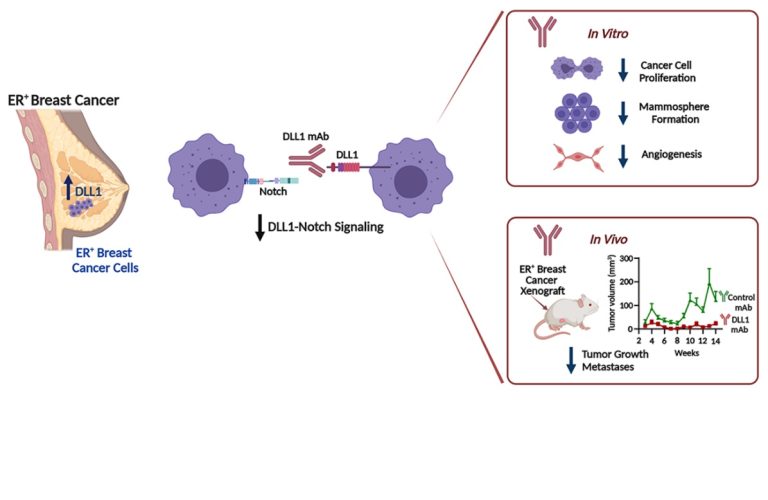
Novel anti-DLL1 antibody with anti-tumor efficacy against breast cancer
Over 70% of breast cancers (BC) are estrogen receptor-positive (ER+). The Notch ligand Delta-like 1 (DLL1) is a key player in ER+ BCs development and aggressiveness and its overexpression are associated with poor prognosis. In this study, Portuguese researchers developed a novel anti-DLL1 antibody that inhibited tumor growth and liver metastases in a xenograft mouse…
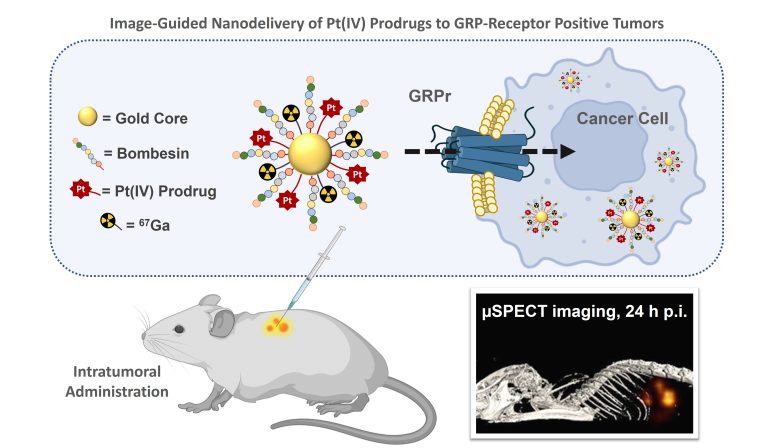
Image-guided nanodelivery of Pt(IV) prodrugs to GRP-receptor positive tumors
Authors and Affiliations: Francisco Silva1,*, Carolina Mendes1, Alice D’Onofrio1, Maria Paula Cabral Campello1,2, Fernanda Marques1,2, Teresa Pinheiro2,3, Kyle Gonçalves1, Sérgio Figueiredo4,5, Lurdes Gano1,2, Mauro Ravera6, Elisabetta Gabano7, António Paulo1,2 1. Centro de Ciências e Tecnologias Nucleares, Instituto Superior Técnico, Universidade de Lisboa, Campus Tecnológico e Nuclear, Estrada Nacional 10, Km 139.7, 2695-066 Bobadela LRS, Portugal….
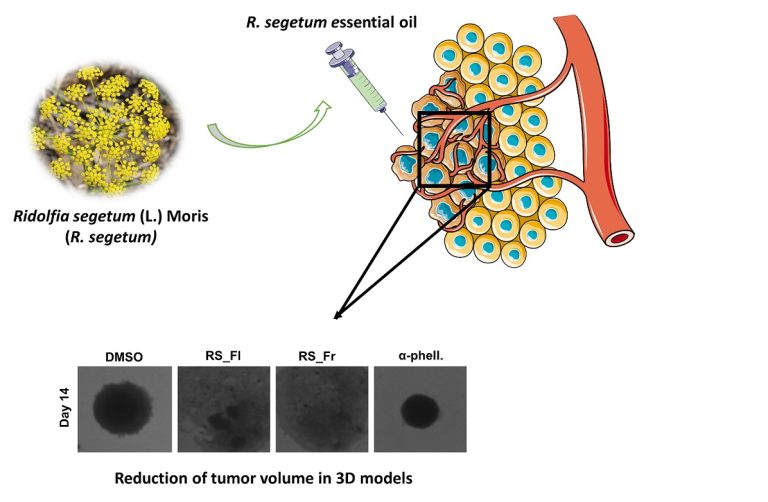
Therapeutic properties of Ridolfia segetum (L.) Moris essential oil against cancer cells
Plants have an important role in traditional medicine, once they present several therapeutic properties, including anti-inflammatory, antioxidant and antitumoral. An interesting fact show that, currently, more than 60% of the available drugs used in the clinic to treat cancer derive from natural products or are inspired in their chemical structure. Therefore, plants play a key…